
Edwards County Probate Court Role
Probate in Edwards County is handled by the Probate Division of the District Court. The Kansas Probate Code is Chapter 59 of the Kansas statutes, and Kansas district courts have jurisdiction over estate administration, probate of wills, guardianships, conservatorships, trusts, and related matters. The practical result is simple: a person looking for Edwards County probate records should start with the Edwards County District Court and the Kansas district court access channels, not a separate county probate office.
Estate administration records may include petitions, the will if there is one, proof of death, notices to creditors, orders appointing an executor or administrator, letters testamentary or letters of administration, inventories, claims, accountings, final settlement filings, and distribution orders. Guardianship and conservatorship probate records may include medical, financial, and incapacity details, so public access can be narrower than ordinary estate access.
The Kansas Probate Code chapter page is the statute source assigned to Edwards County probate records.
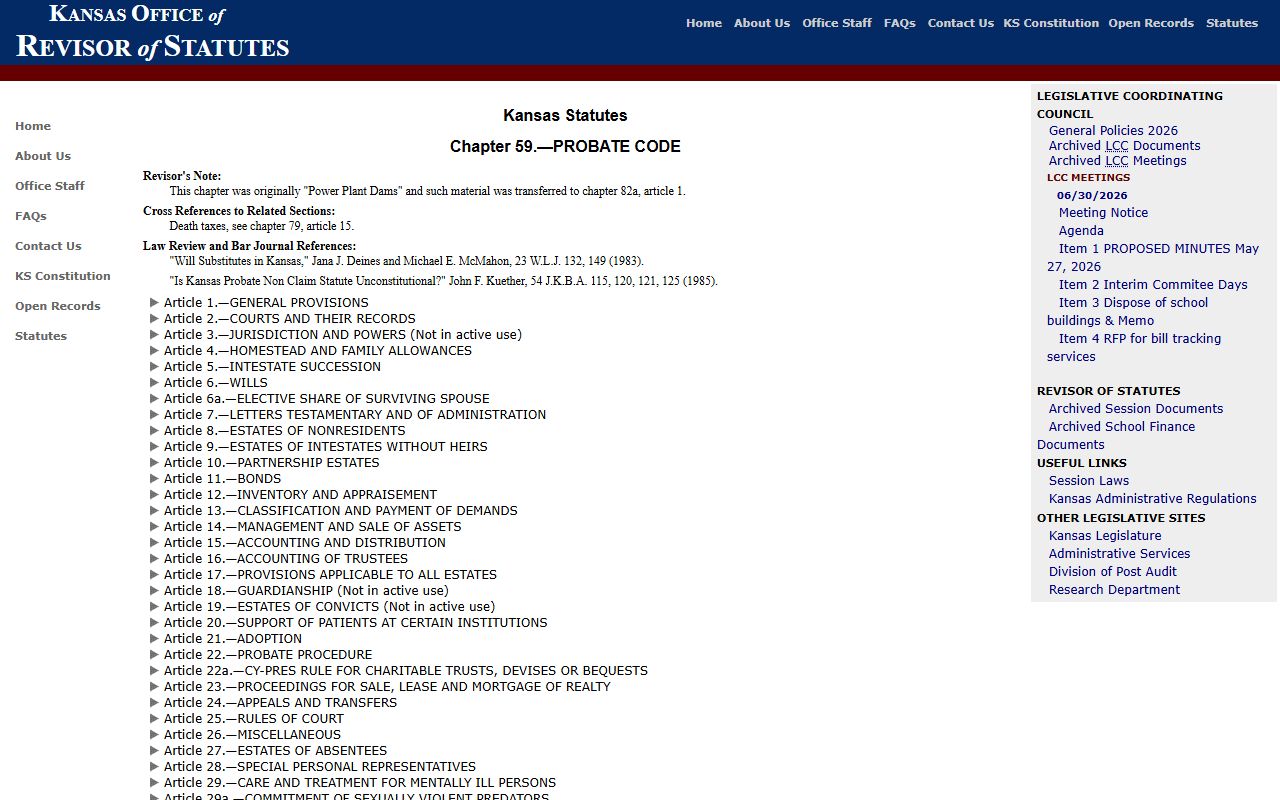
Chapter 59 is the statutory framework behind local probate filings, while the Edwards County District Court is the local filing and record-access point.
Edwards County Probate Terms
Probate records use terms that can be clear once the role is identified. The words below appear often in estate and protective case files. They also help distinguish a will record from an estate case, and a guardianship from a conservatorship. When a search result is unclear, the case title and case type usually show whether the matter is an estate, a trust, a guardianship, or another probate category.
- Testator
- A person who made a will.
- Executor
- The person named in a will to carry out the estate plan, if appointed by the court.
- Intestate
- Dying without a valid will, so Kansas intestacy rules guide distribution.
- Guardianship
- A court case about personal care decisions for a minor or adult who needs protection.
- Conservatorship
- A court case about control or protection of another person's money or property.
The K.S.A. 59-610 statute page is one example of a probate-related Kansas provision assigned in the manifest.
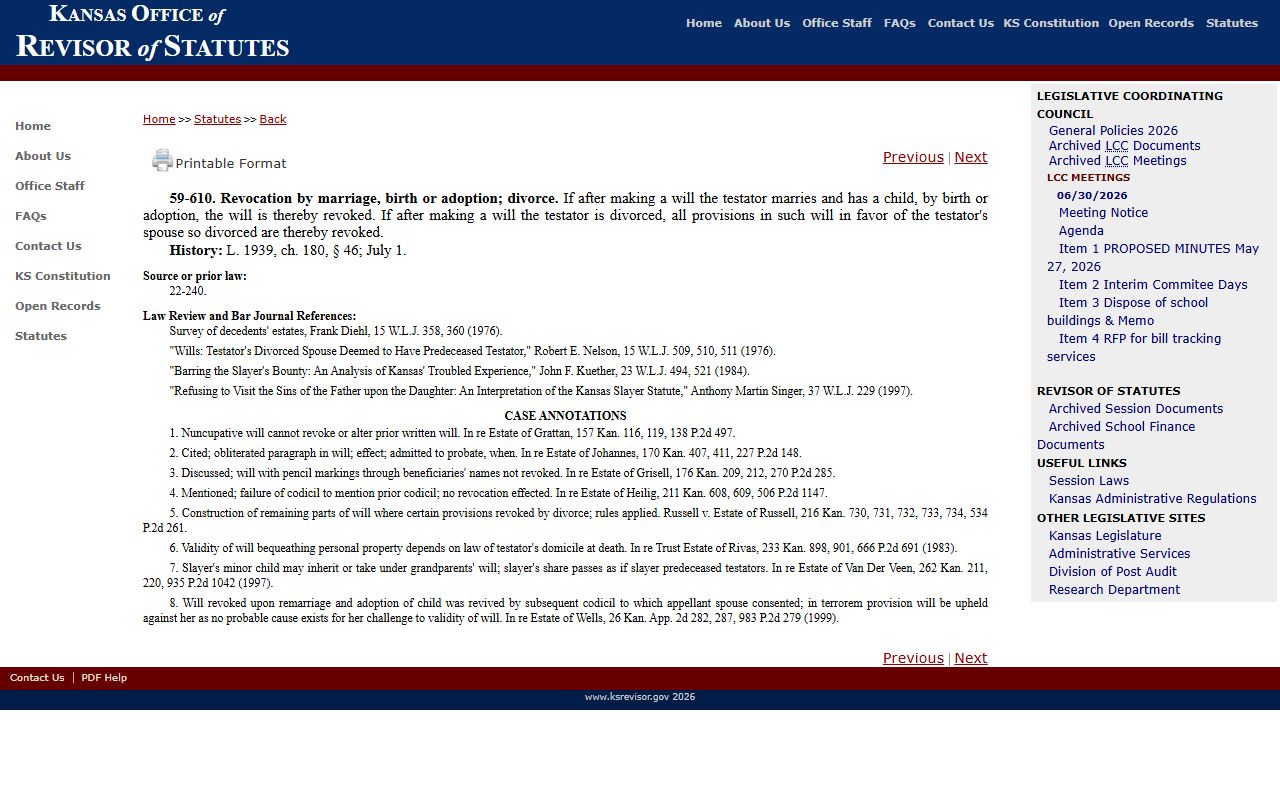
Statute citations help confirm the legal basis for probate events, but the actual Edwards County probate record is still found through the court file.
Search Edwards County Probate Records
There are four documented probate access channels for Edwards County. First, use Kansas CaseSearch for public probate case information when the case is available online. Second, use the courthouse public terminal for probate records that are not online or are easier to locate locally. Third, contact the Clerk of the District Court for certified copies, older files, or non-digitized probate documents. Fourth, use Kansas Judicial Council legal forms and the Kansas Probate Code when trying to identify the right filing type before a new probate case is opened.
- Search by case number if a will, notice, attorney letter, or court order gives the probate case number.
- Search by estate name, decedent name, ward name, conservatee name, trustee, petitioner, or interested party.
- Filter by Edwards County or the 24th Judicial District if the search tool offers a county or district field.
- Use the courthouse terminal or clerk request channel if the probate record is older, incomplete online, or needs certification.
- Ask the court about access limits before expecting to view guardianship, conservatorship, sealed, or medical material.
| Field Label | Type | Required | Options or notes |
|---|---|---|---|
| Case number | Text | Optional | Use the exact probate case number when known. |
| Estate or party name | Text | Optional | Search decedent, petitioner, guardian, conservator, ward, trustee, or interested party. |
| County or district | Filter | Optional | Use Edwards County or 24th Judicial District if available. |
| Case type | Dropdown or filter | Optional | Probate, estate, guardianship, conservatorship, or trust if exposed by the portal. |
Edwards County Probate Court Contact
Only one local probate court channel is documented for Edwards County: the Probate Division of the District Court at the Edwards County Courthouse in Kinsley. Kansas court research lists the district court at the courthouse address with a post office box. The research did not confirm a separate official probate phone number from accessible text, so use the main county number or the Kansas court page and verify the current district court contact before traveling or mailing original documents.
Probate Division of the Edwards County District Court
Edwards County Courthouse
312 Massachusetts Ave.
PO Box 232
Kinsley, KS 67547
(620) 659-3000 main county phone
District court hours researched as 8 a.m. to noon and 1 p.m. to 5 p.m.; verify before visiting.
Note: Probate is a district court function in Edwards County, so avoid sending estate filings to the separate Edwards County Clerk unless the court directs it.
Edwards County Probate Filing Fees
Probate fees in Edwards County come from Kansas district court fee schedules and K.S.A. 59-104 references in the research. These are filing fees for probate proceedings, not attorney fees, publication costs, bond premiums, appraisal costs, or copy charges. Certified copies of court documents follow the general Kansas court-copy fee pattern, including 25 cents per page, $10 per certified document, and mailing charges when copies are sent by mail.
| Probate filing or proceeding | Statute | Total |
|---|---|---|
| Conservatorship and/or guardianship | K.S.A. 59-104 | $91.50 |
| Trusteeship | K.S.A. 59-104 | $91.50 |
| Filing will and affidavit | K.S.A. 59-104 | $70.50 |
| Determination of descent of property | K.S.A. 59-104 | $71.50 |
| Probate of estate or will | K.S.A. 59-104 | $131.50 |
| Refusal to grant letters of administration | K.S.A. 59-104 | $70.50 |
| Termination of joint tenancy | K.S.A. 59-104 | $70.50 |
| Termination of life estate | K.S.A. 59-104 | $70.50 |
| Certified probate proceedings from out of county | K.S.A. 59-104 | $45.50 |
| Decrees in probate from another state | K.S.A. 59-104 | $195.00 |
What Edwards County Probate Records Show
Estate probate records can show how property moves after death. A record may identify the decedent, petitioner, heirs, devisees, personal representative, attorney, creditors, property inventory, claim deadlines, hearing dates, orders, letters, accounting, final settlement, and distribution. Some wills are deposited or filed before a full estate administration begins. Kansas Probate Code research also notes small estate affidavit materials through the Kansas Judicial Council, which may be relevant when formal administration is not needed.
Guardianship and conservatorship probate records serve a different purpose. They may identify the proposed ward or conservatee, relatives, medical or capacity concerns, financial assets, bond, annual reports, inventories, and court orders. Because these files may include health, incapacity, financial, minor, or safety information, access can be redacted or limited. The public case title may exist even when sensitive documents are not viewable through the public portal.
The K.S.A. 38-2212 restriction page is assigned to probate because some protective and child-related court records have special access limits.
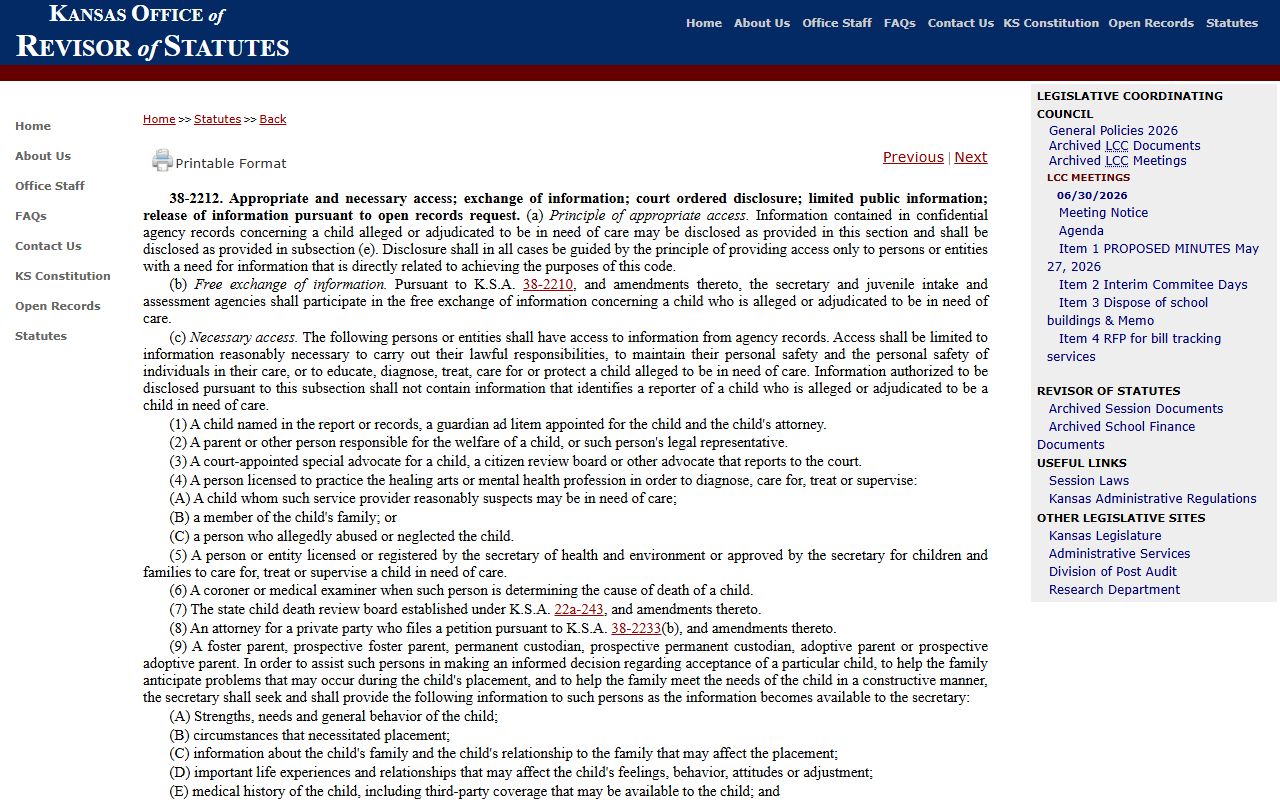
This restriction source is a reminder that not every court record connected to family, child, or protective proceedings is open like a routine estate docket.
Edwards County Probate Process
A typical Edwards County estate starts with the District Court because probate is local court work. If there is a will, the person who holds it should not leave it in private hands after death. If the estate is small enough, Kansas small estate affidavit materials may be the first form set to review. If formal administration is needed, the case usually moves through petition, filing fee, notice, appointment, letters, inventory, creditor claims, accounting, and distribution.
Probate flow: Petition filed › Notice given › Representative appointed › Letters issued › Inventory filed › Claims resolved › Accounting reviewed › Final distribution ordered.
Contested wills, real property, creditor disputes, missing heirs, multi-state assets, guardianship issues, or conservatorship accounting can lengthen the case. Routine estates may still take months because notice and claim periods must run before final distribution. A signed court order, not an online search result, is the controlling record for final probate action.
Probate Records and Bankruptcy
Most Edwards County probate records stay in Kansas district court. Federal bankruptcy records may matter only when an estate, heir, debtor, creditor, or property dispute also has a bankruptcy case. Bankruptcy does not replace probate, but it can affect claims, automatic stays, sale authority, or distribution timing. Federal bankruptcy case information for Kansas is maintained by the U.S. Bankruptcy Court for the District of Kansas, not by the Edwards County Probate Division of the District Court.
The U.S. Bankruptcy Court for the District of Kansas is included in the Edwards County probate manifest for federal overlap research.
Use the bankruptcy court only for federal bankruptcy records; estate administration and will probate remain Kansas district court matters.
The Kansas bankruptcy CM/ECF case information page explains the federal electronic record channel.
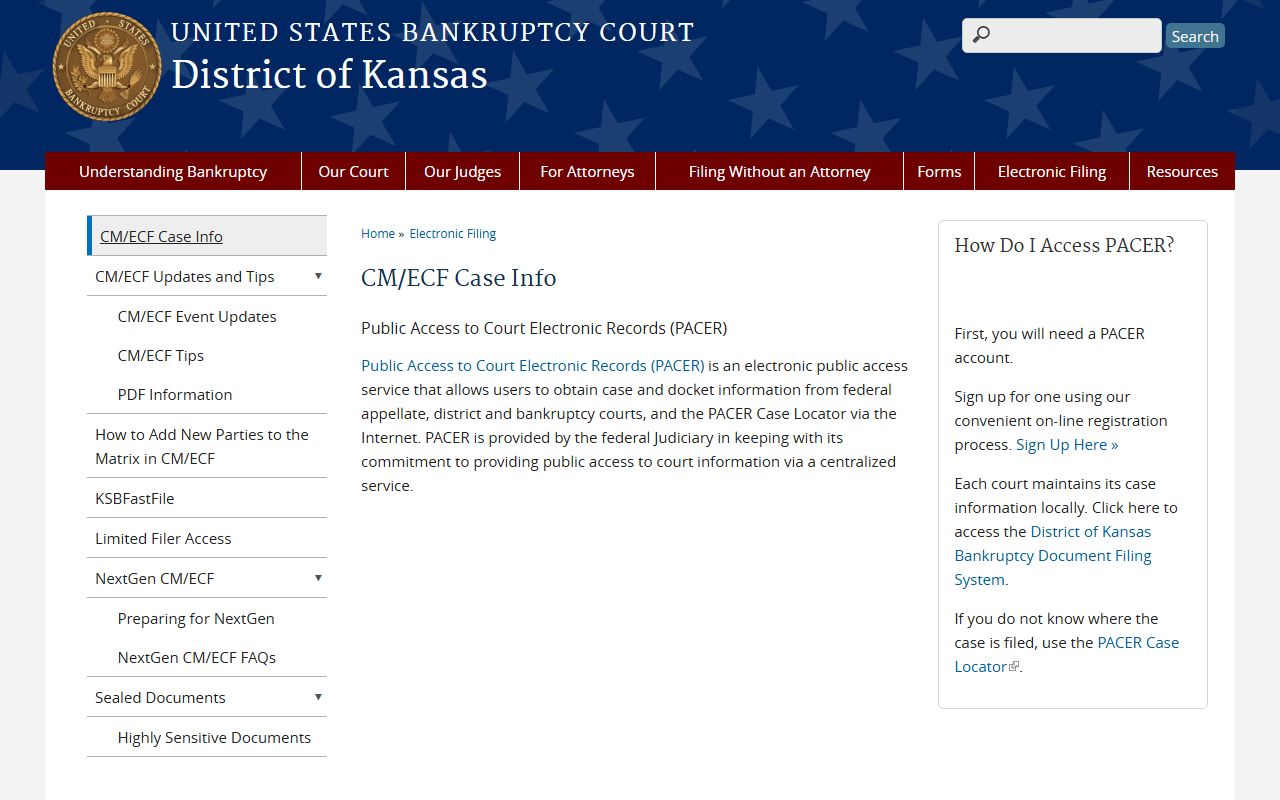
Federal CM/ECF and PACER records can show a bankruptcy docket, but they do not show the local Edwards County probate docket unless a probate order is filed in the federal case.
The Kansas bankruptcy CM/ECF login is the electronic filing access point for registered federal users.
Members of the public usually view federal bankruptcy documents through the correct federal public-access channel rather than filing through CM/ECF.
Restricted Edwards County Probate Records
Probate records are not all open in the same way. A will admitted in a routine estate may be public, while records involving minors, guardianship, conservatorship, medical capacity, sealed filings, or protected identifying details may be closed or redacted. Kansas court access rules and specific statutes control what appears online, what can be inspected at a terminal, and what requires a court order or proof of authority.
For certified probate copies, provide the case number if known, the estate or party name, the exact document needed, and the number of certified copies. If the matter involves a ward, conservatee, minor, or sealed record, ask the Clerk of the District Court what authority is required before submitting payment. That avoids paying for a request that the court cannot release through an ordinary public channel.